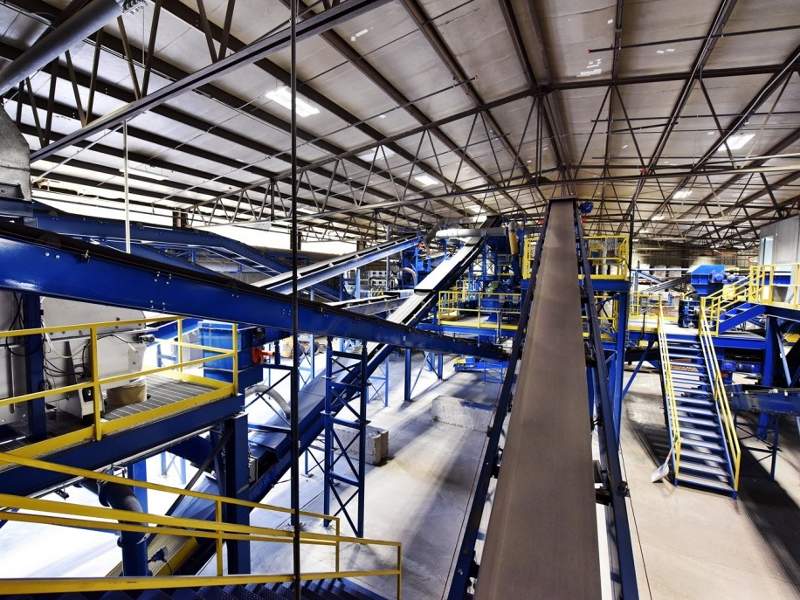
Pop your glass waste into a Lyco glass only bin -no need to separate colours, we’ll do that for you!The Lyco team will come and empty your glass bins on the day(s) that best suits your business needs – easy peasy!Now for the really cleaver bit…Processing – once collected, your glass is taken to a state of the art plant ready to be turned back into jars and bottle, here’s how!… Raw cullet (glass) is fed into reception hopper > as the glass moves through the plant on a conveyor belt, an overhead magnet removes metal> Material is then screened into 3 fractions pre organic removal
(The Organic Separator ORSE is used in the glass recycling industry. This separator is able to separate light-weight contaminations e.g. plastic caps, paper etc. from crushed cullet(broken glass). It is used for pre-sorting and purifies the infeed material for glass separation.)
1) Sub 12mm organic material removed with Orse separator2) Sub 30mm organic material removed with Orse separator3) Plus 30mm organic material removed with Orse separator> Plus 30mm material hand picked> Plus 30mm material roller crushed to aid processing> Overhead magnet removes further metal from sub 30mm materialAll material is then de-labelled > All material is dried and de-dusted > Material is screened to remove fine fractions below 3mmEddy current used to remove aluminium (An eddy current separator (ECS) is a machine that uses a powerful magnetic field to separate non-ferrous metals from an input waste or ore stream. The device makes use of eddy currents to effect the separation. Non-ferrous metals typically separated by an ECS include aluminum, copper and die-cast metals)
Material is then screened to remove fines, separated into two fractions pre processingx1 spectrum unit remove amber from the material stream, it is then crushed to size2x K9 processors remove ceramic, porcelain, stone, metals and heat resistant glass2 xK9 processors remove green cullet from the material stream, it is then crushed to size2 xK9 processors remove flint (clear glass) from the material stream, it is then crushed to size
*** for each stage of separation a second unit is used to enhance colour purity, reduce contamination & reduce glass loss. The recovered glass is returned to the start of the process for secondary stage screening
Now… we have the good stuff! You have your pure green glass, your clear glass (flint) and your amber – becoming a raw materialraw material in then heated into liquid glass > the liquid glass is then moulded into bottle and jars glass bottles and jars are now ready to be filled and distributed to the supermarkets, bars, restaurants and hotels… once used… pop your glass into a Lyco glass bin and we’ll start the process all over again

 Raw cullet (glass) is fed into reception hopper > as the glass moves through the plant on a conveyor belt, an overhead magnet removes metal> Material is then screened into 3 fractions pre organic removal
(The Organic Separator ORSE is used in the glass recycling industry. This separator is able to separate light-weight contaminations e.g. plastic caps, paper etc. from crushed cullet(broken glass). It is used for pre-sorting and purifies the infeed material for glass separation.)
1) Sub 12mm organic material removed with Orse separator
2) Sub 30mm organic material removed with Orse separator
3) Plus 30mm organic material removed with Orse separator
> Plus 30mm material hand picked
> Plus 30mm material roller crushed to aid processing
> Overhead magnet removes further metal from sub 30mm material
All material is then de-labelled > All material is dried and de-dusted > Material is screened to remove fine fractions below 3mm
Eddy current used to remove aluminium (An eddy current separator (ECS) is a machine that uses a powerful magnetic field to separate non-ferrous metals from an input waste or ore stream. The device makes use of eddy currents to effect the separation. Non-ferrous metals typically separated by an ECS include aluminum, copper and die-cast metals)
Material is then screened to remove fines, separated into two fractions pre processing
x1 spectrum unit remove amber from the material stream, it is then crushed to size
2x K9 processors remove ceramic, porcelain, stone, metals and heat resistant glass
2 xK9 processors remove green cullet from the material stream, it is then crushed to size
2 xK9 processors remove flint (clear glass) from the material stream, it is then crushed to size
Raw cullet (glass) is fed into reception hopper > as the glass moves through the plant on a conveyor belt, an overhead magnet removes metal> Material is then screened into 3 fractions pre organic removal
(The Organic Separator ORSE is used in the glass recycling industry. This separator is able to separate light-weight contaminations e.g. plastic caps, paper etc. from crushed cullet(broken glass). It is used for pre-sorting and purifies the infeed material for glass separation.)
1) Sub 12mm organic material removed with Orse separator
2) Sub 30mm organic material removed with Orse separator
3) Plus 30mm organic material removed with Orse separator
> Plus 30mm material hand picked
> Plus 30mm material roller crushed to aid processing
> Overhead magnet removes further metal from sub 30mm material
All material is then de-labelled > All material is dried and de-dusted > Material is screened to remove fine fractions below 3mm
Eddy current used to remove aluminium (An eddy current separator (ECS) is a machine that uses a powerful magnetic field to separate non-ferrous metals from an input waste or ore stream. The device makes use of eddy currents to effect the separation. Non-ferrous metals typically separated by an ECS include aluminum, copper and die-cast metals)
Material is then screened to remove fines, separated into two fractions pre processing
x1 spectrum unit remove amber from the material stream, it is then crushed to size
2x K9 processors remove ceramic, porcelain, stone, metals and heat resistant glass
2 xK9 processors remove green cullet from the material stream, it is then crushed to size
2 xK9 processors remove flint (clear glass) from the material stream, it is then crushed to size
 *** for each stage of separation a second unit is used to enhance colour purity, reduce contamination & reduce glass loss. The recovered glass is returned to the start of the process for secondary stage screening
Now… we have the good stuff! You have your pure green glass, your clear glass (flint) and your amber – becoming a raw material
raw material in then heated into liquid glass > the liquid glass is then moulded into bottle and jars
glass bottles and jars are now ready to be filled and distributed to the supermarkets, bars, restaurants and hotels… once used… pop your glass into a Lyco glass bin and we’ll start the process all over again
*** for each stage of separation a second unit is used to enhance colour purity, reduce contamination & reduce glass loss. The recovered glass is returned to the start of the process for secondary stage screening
Now… we have the good stuff! You have your pure green glass, your clear glass (flint) and your amber – becoming a raw material
raw material in then heated into liquid glass > the liquid glass is then moulded into bottle and jars
glass bottles and jars are now ready to be filled and distributed to the supermarkets, bars, restaurants and hotels… once used… pop your glass into a Lyco glass bin and we’ll start the process all over again